Showing posts with label Public Official. Show all posts

Monday, October 1, 2012

Our Qtrly Dash Notary Online Scavenger Hunt Winner


Every Qtr Dash Notary host an Online Scavenger Hunt where folks search the description for the hint then go on www.dashnotary.com to "hunt" for the 1 x 1 inch photo that is the item. Then they submit the Contact Me form with the proper item and where it is at. It is a 1 - 25 chance to win $100.00 Visa Gift Card. Please be on the look out for our next contest. Warmly, Tonie Boaman, 24 hour traveling notary public

Monday, August 20, 2012

Dash Notary Online Scavenger Hunt ends 9/29 & 1 in 25 chance to win!

Dash Notary's Online Scavenger Hunt Rules
Dash Notary Online Scavenger Hunt! Did you know busy notaries are "Always Using Paper" for documents --- Find it / Submit / Win! Hint is in the above paragraph & Good luck! Feel Free to Share this with your friend(s) too!

HP Officejet Pro 8600 e-All-in-One CM749A#B1H (Google Affiliate Ad)Hammermill - Copy Plus Copy Paper, 20lb, 92 Bright, 8-1/2 x 11" - (Google Affiliate Ad)

Thursday, February 23, 2012

(Reuters) - Nearly 12 million Americans were victims of identity theft in 2011, an increase of 13 percent over 2010

according to a report released on Wednesday by the research firm Javelin Strategy & Research.

Another headline other day:

(Android Security issues) 5 million of Android devices got infected by virus, security giant Symantec says.

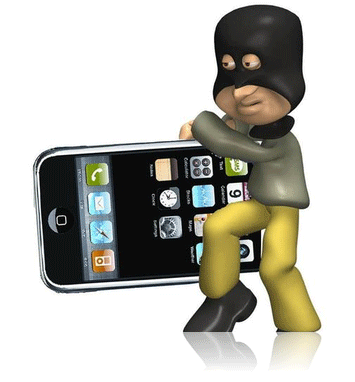
The above has been a well known issue with androids since the release.... with so much ID theft via phones why are folks not paying attention?

Here are a few tips:

From Javelin to avoid becoming an identity fraud victim and mitigating losses:

- Password protect your home and mobile devices. Avoid exposing personal information that can be used by someone else for identity verification.
- Be careful about the apps you download. Only download through a service that monitors the apps, such as iTunes.
- Share information carefully when you are on a public wifi network.
- Monitor your credit cards by checking their use online or reading the statements carefully. Quickly report to your credit card issuer if you see any suspicious transactions.
- Take data breach notifications seriously. If your data has been accessed, consider subscribing to a credit-monitoring service, which is often is offered for free for a year by the company that had been breached.

~~~~~~~~~~~~~~~~~~~~~~~and more Tips from me:


1. Lock your screen with a pin code or password. While this seems simple, anything that provides an extra layer of difficulty for an untrustworthy user is beneficial.
2. Install and enable remote services. All major smartphone operating systems (Blackberry, iOS, Android, Windows Mobile) can be enabled with some or all of these features: remote lock, remote wipe, and even GPS location (for finding where your phone went) are available in many cases. This goes hand in hand with No. 3.

3. Back up your data. Either through a product that offers this functionality, or simply by copying your documents, pictures and info to your computer. This can save you in the event of a lost, stolen, destroyed, or otherwise non-functioning phone.
4. Use encryption where available. Though not offered on every platform, if you can use it, you should. Even in cases where you lock your phone, the data on your device storage can, in some cases, be accessible unless it is encrypted. This includes external memory cards, such as SD cards, installed in the device as well.
5. Use Antivirus. The mobile malware landscape is developing more quickly now than ever before, due to increased reliance on smartphones for everyday tasks such as banking, paying bills, and managing finances. As a direct result, malware writers will likely show an ever increasing interest in gaining access to your money.

Friday, January 27, 2012

The Importance Of Character....

In Leadership From The Inside Out, the late Kevin Cashman makes a powerful distinction between character, the essence of who we are, and persona, the external personality we have created to cope with our everyday life. A leader who leads through character is guided by authenticity, while the one who leads from persona is guided by image.

The former has trust and compassion as foremost guiding principles, while the latter is concerned about fear and self-interest. The leader who leads through character is focused on creating value and contribution rather than winning at all costs. Such a leader values openness and inclusion, shunning control and exclusion, the hallmarks of the leader who is driven by image.
Here are a few tips to inspire you in your leadership journey:
1. Make values actionable
Living your values every day is an important aspect of character in action. Companies go through considerable expense having consultants craft value statements that, unfortunately, end up being nothing more than motherhood statements hanging on the wall in the reception lobby. Prevent this from happening by making values actionable. “We value open communication” is vague and left to interpretation. Consider what happens if you clarify this by adding: “There are no sacred cows in this team.”
2. Be known as a promise-keeper
In The Leadership Challenge, authors James Kouzes and Barry Posner consider “Model the Way” through personal example and dedicated execution, as a foundational practice for admirable leaders. One way to put this into action is to keep your promises, to do what you say you will do. No matter how small the promise is, no matter who the promise is made to, strive to keep your word. While events may well prevent us from honoring commitments we made, don’t let a commitment slip by without getting back to people to let them know why you can’t fulfill your promise. Resolve to handle your word as precious currency and watch how your value rises in everyone’s eyes.
3. Don’t take shortcuts in quality
As Henry Ford put it: “Quality means doing it right when no one is looking.” Do you preach to your team that quality is an important value, yet when there is a crisis, you find yourself telling people to take shortcuts at the expense of quality in order to get the order out the door? Every time you do this, it erodes your authenticity in the eyes of your constituents. Eventually, when you speak about quality, they will discount it as lip service.
4. Be consistent in your dealings with others
Do you treat some people in your organization or team better than you treat others? For example, do you unwittingly complain about a member of your team to other team members? While we can easily slip into such behavior, especially when we are tired and frustrated by the day’s events, consider that this chips away at your integrity as a leader.
5. Audit your decisions
At the end of every week, get in the habit of going over each decision you made. Did your focus on the bottom line cause you to forget the impact on some people? Did your biases affect the objectivity of your actions? Are you proud? Do your actions reflect positively on you as a person of character? What could you have done better? Every action we take, no matter how small, has our character stamp on it.
According to Biology Letters’ “Cues of being watched enhance cooperation in a real-world setting,” one of the reasons we are more civilized when we know we are being watched is due to concerns about our reputation. Reputation is the quality or character that other people attribute to us; it’s the surface layer. It’s our carefully crafted profile on Facebook; it’s the multitude of recommendations that are posted on our LinkedIn profile.
Character, on the other hand, is what is deep inside us; it’s who we are on a daily basis, when things go well and when things go wrong. It’s who we are in the boardroom as well as in our living room. We have reason to be proud when both reputation and character are a mirror image of each other. Abraham Lincoln put it this way: “Character is like a tree and reputation like its shadow. The shadow is what we think of it; the tree is the real thing.”  Bruna Martinuzzi President, Clarion Enterprises Ltd
_____________________________________________________________________
My whole point in posting this was to make folks think about who they are recommending and why?  Is it someone or company with Character and Integrity? or is it someone you just met and liked but have no real knowledge of their company or character. 

So many times in life we pass the day away with no real thought other than to make sure everything is taken care.  No thought of how we are affecting others with our decisions.....

Let's start the new year with a bolder vision of who we truly are both in the professional and personal venue.  By bolder vision, I meant take your expectations of 2012 and go ahead and increase it by 10%.  Sit down and find out why you hamper yourself with the constraints we put on ourselves everyday because we do not have this or that.  If we put away the negative thinking and do a weekly "Character" check of our decisions I truly feel 10% is a no-brainer to achieve in a yearly basis.
Tonie Boaman, Dash Notary

Wednesday, December 14, 2011

Another question that keeps coming up, Can you back-date a mortgage?

Back-dating a loan signing is both unethical and illegal, as you would be knowingly notarizing a document that contains false information.

Furthermore, a document dated after the date of notarization risks rejection by a recorder, as it indicates it was notarized before it was signed.  This occurrence would cause delays in the document processing, and you could be held liable for any resulting legal damages.

Tuesday, November 1, 2011

More States Join In BANNING online webcam Notarizations

A growing number of states is taking aim at online webcam notarization's, declaring them illegal because signers are not physically present before the Notary.

   Ohio and Oregon recently became the latest states to issue alerts on their websites reminding Notaries that webcam notarizations are not permitted and that signers must appear in person before a Notary in order to have documents lawfully notarized.

   "Appearance with a Notary Public via webcam does not meet the requirements of a valid notarization under Ohio las," a scam alert posted on Ohio Attorney General Mike DeWine's blog warns.

   The alert on the Oregon Secretary of State's website warns that a video image or other form of non-physical representation does not meet the state's personal appearance  requirements and cautions Oregon Notaries that participating in webcam notarizations could lead to possible administrative, criminal or civil penalties.

    In recent months, a growing number of U.S. states and territories-- including New Jersey, Colorado, Nevada, Rhode Island, Wisconsin, Oklahoma, the Northern Marianas and California -- have declared that using webcams for notarial acts is illegal.

Thanks to the The National Notary Magazine for this information!

Thursday, September 1, 2011

Help Support Great Charity While giving others great trustworthy notary service!

Facebook Deal Supporting Twin Towers Orphan Fund
I am happy to help support Twin Towers Orphan Fund this month every deal that is closed I will donate $3.00 ♥ http://www.ttof.org/html/ Please share this deal with anyone whom needs notary services day or night in N. Texas. Help Me Help A Great Cause on the 10th Anniversary!

Monday, August 29, 2011

Is there a specific Texas law that prohibits a notary from notarizing their own document or one in which they have a financial interest?

RESPONSE:

You would like to know which Texas law prohibits a notary from notarizing his or her own document, or a document in which he or she has a financial interest.
A statement on the Texas Secretary of State’s website provides a quick answer to your concern: “…notarizations should not be performed by a notary public who is a party to the instrument or financially or beneficially interested in the transaction. The facts in each situation will determine whether the notary’s action was proper.”
However, as you have accurately determined, a specific Texas law does not exist to answer to your question.
This notary rule has been determined through rulings of higher Texas courts. Two cases that can be cited are Morris v. Dunn, 164 S.W.2d 562, 563 (Tex. Civ. App.–Fort Worth 1942, no writ); and Terrell v. Chambers, 630 S.W.2d 800. Both of these cases are summarized in the American Association of Notaries’ Texas Notary Public Manual, 2nd edition, 2006 (25-26).

However, the Texas Legislature has specified two situations in which there are no such disqualifications:
-An employee of a corporation may take an acknowledgment or proof of a written instrument in which the corporation has an interest, or
-An officer of a corporation who is a shareholder in the corporation may do likewise unless the corporation has 1,000 or fewer shareholders and the officer owns more than one-tenth of one percent of the issued and outstanding stock.
These are outlined in Texas Civil Practice and Remedies Code, Section121.002.
It stands to reason that if one cannot notarize a document in which he or she has a financial or personal interest in, one cannot notarize his or her own document.

Good Rules to Follow in All States:

A notary public taking an acknowledgement cannot also be:
-a party to the instrument, e.g. grantor or grantee, including named Trustee in a Deed of Trust
-a spouse of a party to the instrument
-a person having a direct financial interest/stake in the transaction producing the instrument, e.g. real estate broker
-a person acting as agent or attorney-in-fact for another party to the instrument

You may also be interested in reading an emailed newsletter article that the AAN published in May, 2011. Examining Notary-Family Conflicts of Interest explains why no state’s laws allow or encourage a notary to notarize a document in which he or she may have a personal or financial interest.


Tuesday, February 22, 2011

What It Means to Be a Public Official

Food for thought for the next time you need a Notary:

Notaries are public officials who are screened and appointed by the 50 states, the District of Columbia and the U.S. territories to serve the public as trusted impartial witnesses in a variety of fraud-deterrent tasks.

What exactly does it mean for a Notary to be a public official?
First, it means that the Notary’s powers are limited to the geographic boundaries of the appointing jurisdiction and to the term of office stipulated in the appointment or commission, which may vary from 2 to 10 years.

Second, it means that Notaries must keep the promise they made in their public oath to obey the law. In performing notarial acts, Notaries must always give precedence to the requirements of law over any other consideration — even the dictates or expectations of an employer, client, friend or family member. Law in all jurisdictions requires the document signer to appear in person before the Notary at the time of notarization. Thus, notarization may never be based on a telephone call or eMail, on the Notary’s mere familiarity with a signature, or on the informal vouching of a third party — practices that are open invitations to fraud.

Third, it means that Notaries must be impartial and neither favor nor discriminate against any person or group for other than lawful reasons. Thus, a Notary must never refuse to serve, or to discriminate in the quality of service offered, because of an individual’s race, nationality, religion, politics, sexual orientation or status as a non-customer.

Fourth, it means that as representatives of the state, Notaries must perform their official duties with an appropriate degree of respect and seriousness for the indispensable role they play in our legal system as a trusted, impartial and official third party.